Original Recordings from the Mainspring Press Collection
The Clef Club Band-Leaders on Records
(1914 – 1922)
James Reese Europe and the Clef Club Orchestra, 1914
At a time when American record companies were loathe to employ Black musicians, at least three band-leaders from Harlem’s Clef Club — James Reese Europe, Dan Kildare, and Ford Dabney — were given recording contracts. They almost certainly would have been passed-over by record company officials had it not been for their affiliation with several well-known White celebrities — Europe with Vernon and Irene Castle, Kildare with Joan Sawyer, and Dabney with Florenz Ziegfeld. Sawyer and the Castles in particular took a considerable risk in hiring them, as this clipping November 1914 clipping from The New York Age suggests:
The recordings capture how these bands sounded when performing for affluent White employers, patrons, and record buyers. How they might have sounded in less contrained settings wasn’t documented on records, but there are occasional clues to be found here, particularly the explosive ending to “Castle House Rag.”
.
DAN KILDARE’S ORCHESTRA (as Joan Sawyer’s Persian Garden Orchestra): Bregiero
New York: May 6, 1914 Columbia A5572 (mx. 36953 – 1) Kildare is not credited on the labels, but any doubt that this was his orchestra is dispelled by numerous 1914 newspaper reports and advertisements like these:
.
.
EUROPE’S SOCIETY ORCHESTRA (James Reese Europe, conductor): Castle House Rag
New York: February 10, 1914 Victor 35372 (mx. C 14433 – 3) Interpolating “The Castles in Europe,” under which title the earliest pressings were issued. Later pressings are labeled “Castle House Rag” (both titles are entered in the Victor ledger).
.
.
LIEUT. JIM EUROPE’S 369th U.S. INFANTRY (HELL FIGHTERS) BAND: That’s Got ’Em
New York: c. May 1919 Pathé 22146 (mx. T 67667)
.
.
LIEUT. JIM EUROPE’S 369th U.S. INFANTRY (HELL FIGHTERS) BAND: Hesitating Blues
New York: c. March 1919 Pathé 22086 (mx. T 67481) Rust’s Jazz Records (6th Edition) and derivative works show a vocal by Nobel Sissle, in error.
.
.
FORD DABNEY’S BAND: Slow Drag
New York: c. August 1919 Aeolian Vocalion 12195 (mx. 2372)
New York Age (December 21, 1916).
.
.
FORD DABNEY’S SYNCOPATED ORCHESTRA: Doo-Dah Blues
New York: March 1922 Puritan (BD&M) 11122 (mx. 1043 – 1)
Atlantic City, New Jersey (June 1921)
The latest editions of Mainspring Press’ free online discographies are now available on the University of California–Santa Barbara’s DAHR website (click the eBooks tab and select “Mainspring Press Discographies”).
JUST ADDED:EDISON CYLINDERS (Complete American Issues, 1897–1930)
.
__________
Re-posting and/or commercial use of these sound files is prohibited. Please report violations to: publisher@mainspringpress.com
Original Recordings from the Mainspring Press Collection
Some Early May 2024 Arrivals
.
SANDERS [SONNY] TERRY: Lost John (EE–)
New York (Havers Studio): December 24, 1938 Library of Congress AAFS 19 (mx. LC 3 – 2493 – B)
A non-commercial issue, produced for the Library of Congress’ Music Division under the supervision of Alan and Bess Lomax. Terry’s first commercial recording session was held four days later, for Columbia, which inexplicably issued the results in its classical Masterworks series.
.
.
GEORGE TYNES’ GEORGIA COTTON PICKERS: Louisiana Bo Bo
(V+ start, rest E–)
New York: January 22, 1930 Harmony 1127-H (mx. [W] 149769 – 2)
George Tynes was conducting a dance band in Boston by 1922. He seems to have adopted the Georgia Cotton Pickers name in the later 1920s, by which time the band was touring and broadcasting extensively throughout New England, with Maine apparently a favorite destination. They made four remarkable sides for Columbia’s cut-rate Harmony line (their only known recordings) during a short stay at New York’s Roseland ballroom. No personnel are listed in the Columbia files;those listed in Rust’s Jazz Records and similar works are from an uncited source, and as such cannot be verified.
New York (799 7th Avenue): August 14, 1928 Brunswick 4030 (mx. E 28057)
.
.
LEW LESLIE’S BLACKBIRDS ORCHESTRA: Magnolia’s Wedding Day (E)
New York (799 7th Avenue): August 14, 1928 Brunswick 4030 (mx. E 28058)
Both selections: No personnel are listed in the Brunswick ledgers. Those listed in Rust’s Jazz Records and similar works are either speculative or from uncited sources, and as such cannot be verified.
.
.
ROY SMECK (banjo) & ART KAHN (piano): Banjokes (E)
New York: July 20, 1927 Columbia 1127-D (mx. W144289 – 5)
.
.
E. P. BAXTER (dulcimer): Medley of Reels (E+)
New York: January 15, 1926 Columbia 556-D (mx. W 141500 – 2)
Accompanied by Henry Ford’s Old Fashioned Dance Orchestra, a three-to-four piece ensemble the racist automaker sponsored for many years in an attempt to counter what he termed “the Africanization of American music” (he utterly failed at his mission, glad to say).
The latest editions of Mainspring Press’ free online discographies are now available on the University of California–Santa Barbara’s DAHR website (click the eBooks tab and select “Mainspring Press Discographies”).
JUST ADDED:EDISON CYLINDERS (Complete American Issues, 1897–1930)
.
__________
Re-posting and/or commercial use of these sound files is prohibited. Please report violations to: publisher@mainspringpress.com
LIEUT. JIM EUROPE’S 369TH INFANTRY (HELL FIGHTERS) BAND: Memphis Blues (EE–)
New York: March 1919 Pathé 22085 (mx. T 67486)
James Reese Europe was not a jazz musician, nor were the Hell Fighters a jazz band, despite ongoing efforts to cast them as such. Rather, the Hell Fighters were an exceptional military band performing what jazz historian Mark Berresford has aptly labeled “proto-jazz.” Europe was murdered by his drummer not long after this recording was made, so we can only guess at his future direction. One likely scenario, given Europe’s background, is that he would have followed the same path as fellow Clef Club member Ford Dabney, whose Syncopated Orchestra faded away after making some pleasant (if not particularly jazzy) dance recordings in the early 1920s. But who knows?
.
.
VAN EPS BANJO ORCHESTRA: San Souci (E–)
New York: c. July 24, 1914 Columbia A1594 (mx. 39502 – 2)
Fred Van Eps (banjo); probably William Van Eps (second banjo) and Frank Banta (piano); unknown (percussion). July 24 is the date on which the master was shipped to Columbia’s pressing plant; the surviving Columbia files do not show the actual recording date, which would have been within a few days of the master-shipment date.
.
.
WAG ABBEY: Xylophone Rag (E–)
London: 1924 Aco G 15526 (mx. G 882)
.
.
GEORGE MORRIS (as Geo. Clinton): The Blackthorns (as “Laughing Jim”) (E–)
London: December 6, 1929 Victory 176 (mx. 809 – 1)
.
.
GEORGE MORRIS (as Geo. Clinton): Darkie’s Dream (E)
London: December 6, 1929 Victory 220 (mx. 807 – 1)
Both selections: A couple of throwbacks to the early 1900s by one of England’s premier finger-pickers. Edward S. Walker said of these recordings in English Ragtime: “First-rate examples of the finger-picking style tradition… Morris’ pedigree was impeccable, extending as far back as lessons from Vess L. Ossman (in 1903) and Joe Morely.” According to Walker, George Clinton was a stage name used by Morris’ father.
.
.
H. PETERSON (as Miss Holsom): Classic Rag (E)
London: July 9, 1929 Victory 234 (mx. 717 -)
One has to wonder what Brian Rust was hearing when he dismissed this piece (in his unfortunate American Record Label Book) as “hardly a rag.” Structurally it is very much a rag, and a classic one at that, which becomes more apparent when the recording is slowed-down. Rust’s mischaracterization might explain the record’s puzzling absence from Edward Walker’s otherwise comprehensive English Ragtime. The recording was also issued on Victory 271 as “Le Chiffon Classique” by Herbert Rogers, and on several other dime-store labels with differing titles and artist credits. So far no publisher credit, copyright registration, or sheet music has been found for “Classic Rag,” suggesting this might be a retitling of another composition — if so, can anyone identify it?
.
Introduced in the autumn of 1928 as a replacement for the Mimosa label, Victory was a six-shilling, seven-inch disc sold by Woolworth’s in England. It was produced by the London-based Crystalate Gramophone Company, which had recently acquired a part-interest in the Regal Record Company (the American producer of the so-called Plaza labels — Banner, Domino, Regal, et al.), explaining the label’s use of some truncated dubbings from Regal recordings.
Like other cut-rate labels, Victory would not have been economically viable had it not been for its reliance upon royalty-free compositions to fill the reverse sides. These included some titles that Crystalate owned outright, but consisted mostly of old public domain material — thus the presence of some wonderful anachronisms like these.
The latest editions of Mainspring Press’ free online discographies are now available on the University of California–Santa Barbara’s DAHR website (click the eBooks tab and select “Mainspring Press Discographies”).
JUST ADDED:EDISON CYLINDERS (Complete American Issues, 1897–1930)
.
__________
Re-posting and/or commercial use of these sound files is prohibited. Please report violations to: publisher@mainspringpress.com
________
Text copyright 2024 by Allan R. Sutton. All rights are reserved.
Original Recordings from the Mainspring Press Collection
Some Little English Hotties (1928 – 1931)
Cut-rate seven- and eight-inch records were all the rage in England in the late 1920s and early 1930s. Many were fine-groove recordings that ran nearly as long as standard ten-inch discs and for the most part were surprisingly well-recorded. Real jazz was rarely to be found, but there were plenty of uptempo arrangements and the occasional hot solo, as these examples show.
Recording dates and pseudonym-unmasking are from British Dance Bands on Records (Brian Rust & Sandy Forbes, 1987). Although seemingly on safer ground here than in his American Dance Band Discography, Rust as usual didn’t cite his sources, so we can’t vouch for the accuracy of this data.
..
.
HARRY HUDSON’S MELODY MEN: How Long Has This Been Going On? (E)
London: April 20, 1928 Edison Bell Radio 849 (mx. 88114)
.
.
HARRY HUDSON’S MELODY MEN: It Don’t Do Nothin’ But Rain (E)
London: April 20, 1928 Edison Bell Radio 849 (mx. 88115)
.
.
ALFREDO & HIS BAND: Singapore Sorrows (EE+)
London: c. July 25, 1928 Edison Bell Radio 876 (mx.88188)
.
.
ORIGINAL HAVANA BAND (“Late of the Savoy Hotel”): She’s a Great, Great Girl (EE–)
London: c. October 16, 1928 Broadcast 305 (mx. Z 665)
.
.
[PETE MANDELL’S] RHYTHM MASTERS: You Baby Me – I’ll Baby You (E)
London: March 22, 1930 Victory 209 (mx. 889 – 2)
A song from the film, “The Girl from Woolworth’s,” which not-so-coincidentally was the chain-store for which Victory records were made.
.
.
HARRY HUDSON’S MELODY MEN (as The Plaza Band): Come On, Baby (E)
London: c. January 2, 1930 Edison Bell Radio 1307 (mx. 89667)
.
.
HARRY HUDSON’S MELODY MEN (as Radio Melody Boys): ’Leven-Thirty Saturday Night (E)
London: c. May 6, 1930 Edison Bell Radio 1345 (mx. 89770)
.
.
JAY WILBUR & HIS BAND (as The Connecticut Collegians): Sunday, Next Sunday (E)
London: April 3, 1931 Eclipse 23 (mx. JW-181 – 2)
The latest editions of Mainspring Press’ free online discographies are now available on the University of California–Santa Barbara’s DAHR website (click the eBooks tab and select “Mainspring Press Discographies”).
JUST ADDED:EDISON CYLINDERS (Complete American Issues, 1897–1930)
.
__________
Re-posting and/or commercial use of these sound files is prohibited. Please report violations to: publisher@mainspringpress.com
Original Recordings from the Mainspring Press Collection
Some April 2024 Arrivals
(Part 1)
.
.
Q. ROSCOE SNOWDEN: Misery Blues (EE–)
New York: c. October 1923 Okeh 8119 (mx. S 71920 – D)
One of the most obscure recording pianists of the early 1920s, Quilla Roscoe Snowden was born in Philadelphia on December 22, 1887, and was raised on Lombard Street (in the same rather rough neighborhood where Victor operated its main studio from September 1901 into early November 1907). In 1917 Snowden moved to New York, where his first published composition (“Deep Sea Blues,” on this record’s reverse side) appeared a year later. He launched his own music publishing company in 1921 but it proved to be short-lived, as did his recording career — Okeh 8119 was his only issued record.
.
.
PRESTON JACKSON & HIS UPTOWN BAND (as Georgia Melody Men): Trombone Man (E– to V++)
Chicago (Rodeheaver Laboratories): c. July 1925 Challenge 803 (Paramount mx. 2650 – 2)
No primary-source documentation exists regarding the personnel on this recording. Personnel listed in Rust’s Jazz Records and derivative works, various LP and CD program notes, etc., are from uncited sources and as such cannot be verified. In early 1928 this was inexplicably recycled as a B-side filler (backing a current pop tune by Harry Reser’s Orchestra) on Sears’ Challenge label. Although not nearly as rare or sexy as the original Paramount issue, it’s a better-quality pressing.
.
.
COW COW DAVENPORT: Cow Cow Blues (EE–)
Chicago: July 16, 1928 Brunswick Collectors Series 80022 (mx. C 2063 – B, first issue)
.
.
COW COW DAVENPORT (Ivy Smith, talking): State Street Jive (EE–)
Chicago: July 16, 1928 Brunswick Collectors Series 80022 (mx. C 2064 – B, first issue)
(Both selections): A pair of 1940s first releases for these previously withheld takes; the original 1928 issue, on Vocalion 1198, used take A on both sides. Somehow the metal parts for these recordings survived the widespread scrapping of early Vocalion race-series masters, so it wasn’t necessary to resort to dubbed masters as was often the case with the Collectors Series issues.
.
.
SAM THEARD (Lovin’ Sam from Down in Alabam’) (Benton Overstreet, piano): Get It in Front (E)
Chicago: October 10, 1929 Brunswick 7131 (mx. C 4636 – )
.
,
SAM THEARD (Lovin’ Sam from Down in Alabam’) (Benton Overstreet, piano): Ain’t Nobody Got Nothin’ (E)
Chicago: October 10, 1929 Brunswick 7131 (mx. C 4635- )
(Both selections): Two takes made of each; the selected takes are not marked in the Brunswick ledgers or on the pressings. H. Benton Overstreet was a Kansas-born pianist and composer of “There’ll Be Some Changes Made,” “A Jazz Holiday,” and other hits in the ’teens and ’twenties. His only other commercially released recordings of which we are aware are two Black Patti sides, accompanying Elnora Johnson. On the other hand, New Orleans-born Sam Theard (a.k.a. “Spo-Dee-O-Dee” in later years) enjoyed a career spanning more than five decades as a songwriter, recording artist, and occasional actor, culminating with cameo appearances on “Sanford and Son” and “Little House on the Prairie” in the 1970s.
.
.
DUKE ELLINGTON & HIS ORCHESTRA (Adelaide Hall, vocal): Blues I Love to Sing (E)
Camden, NJ: October 26, 1927 Victor 21490 (mx. BVE 39371 – 1)
.
.
DUKE ELLINGTON & HIS ORCHESTRA: Blue Bubbles (E)
New York (Liederkranz Hall): December 19, 1927 Victor 21490 (mx. BVE 41246 – 1)
(Both selections) No personnel listed in the Victor files. Those listed in Rust’s Jazz Records, various LP and CD program notes, etc., are from uncited sources, and as such cannot be verified.
The latest editions of Mainspring Press’ free online discographies are now available on the University of California–Santa Barbara’s DAHR website (click the eBooks tab and select “Mainspring Press Discographies”).
JUST ADDED:EDISON CYLINDERS (Complete American Issues, 1897–1930)
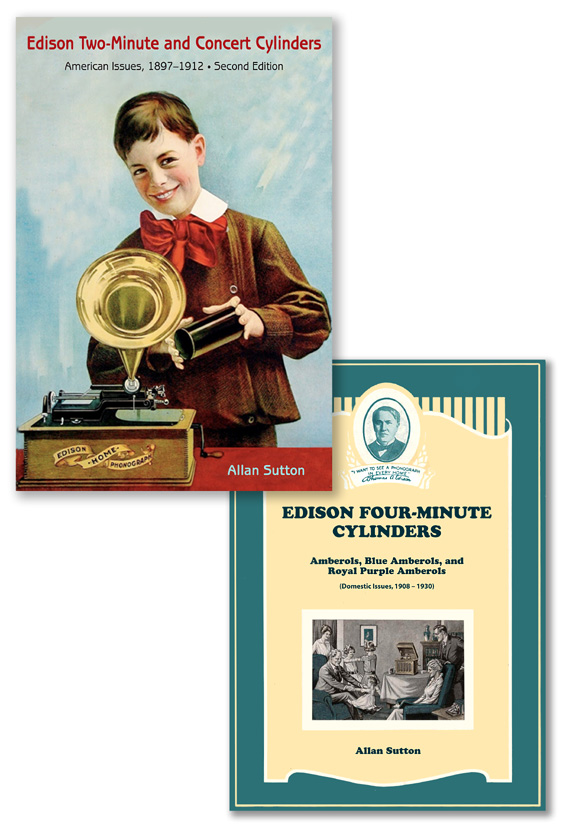
Revised editions of two important books documenting Edison cylinder recordings have been published by UCSB’s American Discography Project. Compiled by Allan Sutton and originally published by Mainspring Press, the new editions are now available as free downloadable eBooks.
Edison Four-Minute Cylinders: Amberols, Blue Amberols, and Royal Purple Amberols includes an illustrated historical introduction, revised recording and/or release dates and recording locations from Edison archival materials; additional details on remakes, alternate versions, cancelled numbers, and direct-versus-dubbed issues; full personnel of vocal backing groups; plus newly added details on instrumental accompanists, band vocalists, conductors, arrangers, artist pseudonyms, uncredited performers, and medley contents; disc takes used in the production of dubbed cylinders, and data for the corresponding wax Amberol and Diamond Disc releases; and expanded listings for private and special-use recordings, including the Ediphone, Kinetophone, and Panama-Pacific cylinders, private issues for Thomas Edison and Henry Ford, etc.
In Edison Two-Minute and Concert Cylinders will be found the first study of these records to be compiled from the surviving company documentation (factory plating ledgers, studio cash books, remake and deletion notices, catalogs, supplements, trade publications, etc.), along with careful inspection of the original cylinders.
Unlike previously published guides, which don’t list the numerous remakes, this new volume shows all known versions (even indicating those initially supplied by Walcutt & Leeds), along with the listing or release dates and distinguishing details for each. Plating dates for brown-wax pantograph masters and early Gold Moulded masters, which provide valuable clues to the long-lost recording dates, are published here for the first time.
Other features include an illustrated, footnoted history of Edison cylinder production during the National Phonograph Co. period; detailed user’s guide, and artist and title indexes.
Originally published as three books between 2009 and 2015 and long out of print, these new editions have been revised and updated with new information based on examination of original documents and artifacts.
Funding for their publication as free eBooks was provided by the John Levin Early Recordings Fund and the William R. Moran Fund for Recorded Sound.
Charlotte, NC (Southern Radio Building): June 16, 1936 Montgomery Ward M-7034 (mx. BS 102651 – 1)
Both selections: Accompanying personnel are unlisted on the labels and in the RCA files. Those listed in Country Music Records are from an uncited source, and as such cannot be verified.
.
.
BILL NETTLES & HIS DIXIE BLUE BOYS: Oxford (Miss.) Blues
Dallas (Warner Bros. Exchange Building): June 22, 1937 Vocalion 03694 (mx. DAL 426 – 2)
.
.
BILL NETTLES & HIS DIXIE BLUE BOYS: Shake It and Take It
Dallas: (Warner Bros. Exchange Building): June 22, 1937 Perfect 7-09-64 (mx. DAL 420 – 1 )
Both selections: Accompanying personnel are unlisted on the labels and in the American Record Corporation files. Those listed in Country Music Records are from an uncited source, and as such cannot be verified.
.
.
LEE O’DANIEL & HIS HILLBILLY BOYS (vocal: Kitty Williamson, as Texas Rose): I’ve Got the Blues
Dallas (Warner Bros. Exchange Building): May 15, 1938 Vocalion 04353 (mx. DAL 559 – 1)
______________
Commercial use and/or re-posting of these sound files is prohibited. Please report violations to: publisher@mainspringpress.com
.
The latest editions of Mainspring Press’ free online discographies are now available on the University of California–Santa Barbara’s DAHR website (click the eBooks tab and select “Mainspring Press Discographies”).
Original Recordings from the Mainspring Press Collection
Vintage Record Playlist • Some Late March Arrivals
.
.
.
EDGEWATER CROWS: No Bonus Blues (E+)
Hattiesburg, Mississippi: July 15, 1936 Melotone 7-01-62 (mx. HAT 103 – 3)
.
.
EDGEWATER CROWS: Swinging Rhythm Around (E+)
Hattiesburg, Mississippi: July 15, 1936 Melotone 7-01-62 (mx. HAT 104 – 3)
Personnel are unknown. The Edgewater Crows made four recordings, of which only these were issued. (Both sides: Take 3 was dubbed from take 1 or 2 on October 5, 1936, three months prior to release, presumably to correct technical problems; no commercial pressings were made from the original takes.)
.
.
LONNIE JOHNSON: Love Is Just a Song (EE+)
New York: August 12, 1932 Columbia mx. W 1522632 – 2 (test pressing)
One of two unissued titles from Johnson’s final Columbia / Okeh session (the other can be heard here). Johnson would not record again until November 1937, when he signed with Decca.
.
.
DE FORD BAILEY: Dixie Flyer Blues (E)
New York: April 19, 1927 Brunswick 146 (mx. E 22501)
Reissued in late 1927 on Vocalion 5180, for which this mx. was renumbered as E 6565. Bailey was the first (and among the very few) Black artists to perform with the “Grand Ole’ Opry.” His Brunswick-Vocalion recordings were issued in the white hillbilly rather than race series.
.
.
LEMUEL FOWLER: Satisfied Blues (EE+)
New York: July 19, 1923 Columbia A3959 (mx. 81107 – 5)
The scarcest by far of Columbia’s proto–race-series issues, having shipped a relatively modest 7,388 copies according to the Columbia files. By way of comparison, shipments in this class averaged around 30,000 copies with some significant outliers, including Clara Smith’s A4000 (more than 206,000 copies), and Bessie Smith’s A3844 (just under 277,000). Fowler often recorded as an accompanist or member of various small bands, but this and “Blues Mixture” on the reverse side were his only issued solos. (The occasional thumping and scraping noises are present in the original recording.)
.
.
VAN EPS BANJO ORCHESTRA: Florida Rag (EE–)
New York: c. August 8, 1914 Pathé B.5035 (mx. 65078; ctl. 3191)
Fred Van Eps (banjo); possibly William Van Eps (second banjo and/or mandolin) and Felix Arndt (piano). This scarce 11½” center-start disc was among Pathé’s initial American offerings in October 1914; markings indicate that it was pressed in France (as a U.S. pressing plant was not yet in operation). The inner margin shows a faintly handwritten “08-8-14,” which probably is a plating or processing date rather than a recording date. Like all acoustic Pathé discs, this one was dubbed pantographically from a cylinder master, producing Pathé’s characteristic rumble. It was later dubbed to standard rim-start format, in other diameters, under different catalog numbers. .
.
______________
Commercial use and/or re-posting of these sound files is prohibited. Please report violations to: publisher@mainspringpress.com
.
The latest editions of Mainspring Press’ free online discographies are now available on the University of California–Santa Barbara’s DAHR website (click the eBooks tab and select “Mainspring Press Discographies”).
Original Recordings from the Mainspring Press Collection
Fletcher Henderson Before Louis (1923–1924)
.
Henderson’s recordings made before Louis Armstrong joined the band in the fall of 1924 are often dismissed by jazz critics, for good reason in many cases. But the best of the pre-Armstrong sides reveal a band already developing a distinctive sound, dominated by Coleman Hawkins’ saxophone work.
.
.
FLETCHER HENDERSON’S ORCHESTRA: Dicty Blues
New York: August 7 or 9, 1923 Vocalion 14654 (mx. 11817) Original file documentation has not survived for this side. The recording date has been given as August 7 (by Frank Driggs at Columbia) and August 9 (by Brian Rust et al.), with no source cited but Driggs being the note trustworthy.
.
.
FLETCHER HENDERSON’S ORCHESTRA: Charleston Crazy
New York: November 30, 1923 Vocalion 14726 (mx. 12376)
.
.
FLETCHER HENDERSON & HIS SAWIN’ SIX: Lonesome Journey Blues
New York (H.S. Berliner Laboratory): c. December 1923 Ajax 17016 (mx. 31023 – 2)
.
.
FLETCHER HENDERSON & HIS CLUB ALABAM ORCHESTRA: Tea Pot Dome Blues
New York: April 15, 1924 Vocalion (Canadian) 14800 (mx. 13024)
.
.
FLETCHER HENDERSON & HIS CLUB ALABAM ORCHESTRA (Rosa Henderson, vocal): Do That Thing
New York: May 28, 1924 Vocalion 14838 (mx. 13275) One of the few Henderson sides with a vocal chorus (Rosa and Fletcher were not related). The color barrier might have worked in Henderson’s favor, in that he was spared having his records ruined by studio hacks like Irving Kaufman and Abe “Arthur Fields” Finkelstein, whose vocal choruses are a blight on so many otherwise fine records by White bands.
.
.
FLETCHER HENDERSON’S DANCE ORCHESTRA: Feeling the Way I Do
New York (Independent Recording Laboratory): May 1924 Regal 9658 (mx. 5497 – 1)
.
.
FLETCHER HENDERSON & HIS ORCHESTRA: He’s the Hottest Man in Town
New York: September 8, 1924 Columbia 209-D (mx. 81981 – 3) From Henderson’s second-to-last session before Louis Armstrong’s arrival. Amstrong made his first recordings with the band on October 7..
_____________
Commercial use and/or re-posting of these sound files is prohibited. Please report violations to: publisher@mainspringpress.com
.
The latest editions of Mainspring Press’ free online discographies are now available on the University of California–Santa Barbara’s DAHR website (click the eBooks tab and select “Mainspring Press Discographies”).
Original Recordings from the Mainspring Press Collection
Victor Tip-Toes into the
Race Record Market (1923)
.
Victor first “Blues” list (August 4, 1923)
.
By the spring of 1923, with the first race record boom well under way, Victor officials must have realized they were missing out on a lucrative new market. An attempt was made to assemble a “blues” roster, although not much effort seems to have been expended. It was composed largely of New York vaudeville-blues singers managed by music-publisher Joe Davis, who supplied complete low-cost packages — songs, singers, accompanists, and copyright clearances — to record companies unable or unwilling to scout for their own Black artists.
Taking no chances, Victor padded-out their initial August 1923 “Blues” list with offerings by Sissle & Blake and Moss & Frye, who were popular across racial lines, and tossed in its best-selling 1921 release by the “Shuffle Along” pit orchestra for good measure. The vaudeville-blues singers were soon dropped, and Victor’s later 1923 releases were much improved, including some solid performances by the likes of James P. Johnson and Piron’s New Orleans Orchestra. Unfortunately, the company abandoned the effort at the end of the year. Its initial foray into the race record market would also be its last until 1926, when a change in Victor ownership and the arrival of Ralph Peer ushered in a new era for Victor in the blues field.
.
.
JAMES P. JOHNSON: Bleeding Hearted Blues
Camden, NJ: July 25, 1923 Victor 19123 (mx. B 28197 – 6)
.
.
LIZZIE MILES (Clarence Johnson, piano): You’re Always Messin’ ’Round with My Man
New York: May 23, 1924 His Master’s Voice (British) B1703 (mx. B 28025 – 3; ctl. 2-3775) Victor’s first vaudeville-blues export. HMV was taking no chances, placing this on the reverse side of Sissle & Blake’s very popular (and decidedly non-bluesy) rendition of “Down-Hearted Blues.”
New York: May 24, 1923 Victor 19084 (mx. B 28026 – 2)
.
.
LENA WILSON (Porter Grainger, piano): Triflin’ Blues (Daddy, Don’t You Trifle)
New York: May 19, 1923 Victor 19085 (mx. B 27895 – 4)
.
.
EDDIE HUNTER & ALEX ROGERS (Luckey Roberts, piano): I’m Done
Camden, NJ: December 17, 1923 Victor 19247 (mx. B 28899 – 6)
.
.
ROSA HENDERSON (acc. Fletcher Henderson’s Orchestra): Midnight Blues
New York: July 19, 1923 Victor 19124 (mx. 29299 – 4) Fletcher Henderson’s Orchestra is not credited in the Victor files; identification is based on the obvious aural evidence as well as long-standing researcher consensus.
.
.
ARMAND J. PIRON’S NEW ORLEANS ORCHESTRA: Mamma’s Gone, Goodbye
New York: December 11, 1923 Victor 19233 (mx. B 29122 -2)
______________
Commercial use and/or re-posting of these sound files is prohibited. Please report violations to: publisher@mainspringpress.com
.
The latest editions of Mainspring Press’ free online discographies are now available on the University of California–Santa Barbara’s DAHR website (click the eBooks tab and select “Mainspring Press Discographies”).
Original Recordings from the Mainspring Press Collection
Vintage Record Playlist • Some Early March Arrivals
.
.
HOCIEL THOMAS: Worried Down with the Blues (E–)
Richmond, IN: April 6, 1925 Gennett 3006 (mx. 12188 – A) Accompanists are unlisted in the Gennett files. Hociel’s pianist and co-composer here is likely her uncle Hersal Thomas, who is known to have accompanied her on some other recordings before his death in 1926. Born in Houston, Hociel and Hersal were well-connected in the blues world as members of an extended family that included Sippie Wallace and Victoria Spivey.
.
.
McKINNEY’S COTTON PICKERS: Milenberg Joys (EE+)
Chicago (952 N. Michigan Ave.): July 11, 1928 Victor 21611 (mx. BVE 46096 – 2)
Chicago (952 N. Michigan Ave.): July 12, 1928 Victor 21611 (mx. BVE 46402 – 3)
Both sides: No personnel are listed in the Victor files; those listed in Rust’s Jazz Records and similar works are from uncited sources, and as such cannot be verified. Victor’s master numbering jumped from 46099 to 46400 in the midst of the July 12 session, thus the large numerical gap between these two masters.
.
.
THOMAS [FATS] WALLER: Hog-Maw Stomp (EE+)
Camden, NJ (church studio): February 16, 1927 …(Ralph Peer, session supervisor) Victor 21525 (mx. BVE 37820 – 2)
.
.
.
ORQUESTA TIPICA “PACHO” (Juan Maglio, director): American Cirque Excelsior (EE–)
Buenos Aires: c. 1912 Columbia (South American) TX760 (mx. 57206 – 1) .
.
ORQUESTA TIPICA “PACHO” (Juan Maglio, director): El Cachafaz (EE–)
Buenos Aires: c. 1912 Columbia (South American) TX760 (mx. 57105 – 2)
Although little-known in the United States, Juan Maglio (Pacho) was a key figure in popularizing the tango in the early 1900s. He recorded prolifically for Columbia in Buenos Aires, sometimes as a soloist on the bandoneon (a type of concertina), but most often with a quartet comprising himself, José Bonano (Pepino) (violin and cornet), Carlos Hernani Macchi (flute), and Luciano Ríos (seven-string guitar).
.
.
JOSÉ MARDONES: Nostalgia (EE–)
Milan: c. 1912 Columbia (South American) S12 (mx. 21586 – 1) Unissued in the Unites States. Mardones later remade this title in 12” form, which was released in the U.S. on Columbia Spanish-series S5193.
.
.
JOSÉ MARDONES: El Tamborilero (EE–)
Milan: c. 1912 Columbia (South American) S12 (mx. 21587 – 1) Unissued in the U.S.
TURKISH TRIO (anonymous keman, oud, canoon): Nihavend March (E–)
Unknown location and date Columbia E3787 (mx. 58753 – 1) The Columbia files for this matrix series — a mish-mash of imported and domestic recordings for the immigrant markets — have not survived. One modern work lists this as a c. November 1917 New York recording, with no source cited, but the unusually narrow groove and presence of a spoken introduction suggest this might be an imported master.
______________
Commercial use and/or re-posting of these sound files is prohibited. Please report violations to: publisher@mainspringpress.com
.
The latest editions of Mainspring Press’ free online discographies are now available on the University of California–Santa Barbara’s DAHR website (click the eBooks tab and select “Mainspring Press Discographies”).
Original Recordings from the Mainspring Press Collection
Vintage Record Playlist • Some Late February Arrivals
.
FAMOUS HOKUM BOYS: That’s the Way She Likes It (V++)
New York: April 9, 1930 Homestead 16098 (mx. 9598 – 2; ctl. 19598)
No personnel are listed in what remains of the American Record Corporation files, but this group normally comprised Thomas A. “Georgia Tom” Dorsey (piano, vocal); Bill Bill Broonzy (guitar, vocal); and Frank Brasswell (guitar, vocal). Although 78 Quarterly magazine stated that no copies of this recording are known on the Homestead label, this is now the third we’ve encountered. Those 78Q rankings are notoriously unreliable — only a very small handful of collectors were surveyed, so many records were ranked as far rarer (or even non-existent, in this case) than they actually are.
.
.
MOZELLE ALDERSON & THOMAS A. DORSEY (as Jane Lucas & Georgia Tom): Terrible Operation Blues (E–)
Richmond, IN: November 19, 1930 Champion 16171 (mx. GN 17276 – B)
Thomas A. Dorsey — “the father of Black gospel music” — in an earlier incarnation (and a highly lucrative one, until it wasn’t anymore, at which point he got religion) — as “the grand-daddy of raunch.”
.
.
BLIND BOY FULLER: Blue and Worried Man (EE+)
New York: March 5, 1940 Columbia mx. W 26594 – A (10¾” original untrimmed test pressing)
Acc: Sonny Terry (harmonica); Oh Red (washboard). Issued on Vocalion 05440 as “Blue and Worried Man” (probably the correct title, although the test-pressing rim and label both show “Blue and Worried Mama.”
.
.
JAZZ BABY MOORE & COMPANY: Morning Prayer (E)
St. Louis: July 28, 1926 Vocalion 1045 (mx. E 3620)
Phillip “Jazz Baby” Moore and unidentified others. Paul Oliver had this to say in his Songsters and Saints (Cambridge University Press, 1984): “A mock prayer, delivered in a fair imitation of a Baptist preacher. The extravagance of language of Baptist and Sanctified Preachers and their concern with contemporary references was sharply observed in Moore’s mimicry.”
.
.
ALLEN BROTHERS: Pile Drivin’ Papa (EE–)
Charlotte, NC: May 20, 1931 (Ralph Peer, session supervisor) Victor 23578 (mx. BVE 69326 – 2)
.
.
ALLEN BROTHERS: Monkey Blues (EE–)
Charlotte, NC: May 21, 1931 (Ralph Peer, session supervisor) Victor 23578 (mx. BVE 69332 – 2)
Both sides: Austin Allen (banjo, vocal) and Lee Allen (guitar, kazoo), per the RCA recording ledger (which does not show a kazoo present — the files are not always infallible!).
.
.
THE ORIGINAL WOLVERINES (Richard Voynow, director): The New Twister (E+)
New York: October 12, 1927 Brunswick 3707 (mx. C 1306)
No personnel listed in the Brunswick files other than Voynow; those listed in Rust’s Jazz Records and elsewhere are from uncited sources, and as such cannot be verified. Voynow managed the actual original Wolverines, the band with which Bix Beiderbecke made his earliest recordings, but this is a later, unrelated group.
.
.
ELMER SCHOEBEL & HIS FRIARS SOCIETY ORCHESTRA: Prince of Wails (E+)
Chicago: October 18, 1929 Brunswick 4652 (mx. C 4560 – )
.
.
ELMER SCHOEBEL & HIS FRIARS SOCIETY ORCHESTRA: Copenhagen (E+)
Chicago: October 18, 1929 Brunswick 4652 (mx. C 4559 – )
Both sides: No personnel are listed in the Brunswick files; those listed in Rust’s Jazz Records and elsewhere are from uncited sources, and as such cannot be verified.
______________
Commercial use and/or re-posting of these sound files is prohibited. Please report violations to: publisher@mainspringpress.com
.
The latest editions of Mainspring Press’ free online discographies are now available on the University of California–Santa Barbara’s DAHR website (click the eBooks tab and select “Mainspring Press Discographies”).
Original Recordings from the Mainspring Press Collection
Some Early February Arrivals (1927 – 1930)
.
.
DIXIELAND JUG BLOWERS: Southern Shout (E–)
Chicago (952 N. Michigan Ave.): June 6, 1927 Victor 20954 (mx. BVE 38636 – 2) No personnel listed in the Victor files other than Clifford Hayes; listings in Jazz Records and elsewhere are from uncited sources and as such cannot be verified.
.
.
TINY PARHAM & HIS MUSICIANS: Skag-a-Lag (E)
Chicago (952 N. Michigan Ave.): February 1, 1929 Victor V-38054 (mx. BVE 48845 – 2)
.
.
TINY PARHAM & HIS MUSICIANS: Voodoo (E)
Chicago (952 N. Michigan Ave.): February 1, 1929 Victor V-38054 (mx. BVE 48844 – 2) Both sides: No personnel listed in the Victor files other than Ralph Peer and Leroy Shield (session supervisors); listings in Jazz Records and elsewhere are from uncited sources and as such cannot be verified.
.
.
JIMMIE LUNCEFORD & HIS CHICKASAW SYNCOPATORS (Moses Allen, preaching): In dat Mornin’ (E)
Memphis: June 6, 1930 Victor V-38141 (mx. BVE 62599 – 2) No personnel listed in the Victor files other than Ralph Peer (session supervisor); listings in Jazz Records and elsewhere are from uncited sources and as such cannot be verified.
.
.
GEORGE E. LEE’S NOVELTY SINGING ORCHESTRA (Julia Lee, vocal): Won’t You Come Over to My House? (EE-)
JULIA LEE with GEORGE E. LEE’S NOVELTY SINGING ORCHESTRA: He’s Tall, Dark and Handsome (EE–)
Kansas City: November 1929 Brunswick 4761 (mx. KC 602 – ) Both sides: The Brunswick recording sheets for these recordings have been lost; personnel listed in Jazz Records and elsewhere are from uncited sources and as such cannot be verified.
__________
Commercial use and/or re-posting of these sound files is prohibited. Please report violations to: publisher@mainspringpress.com
The Association for Recorded Sound Collections is pleased to announce the recipients of the ARSC Award for Independent Initiatives:
Colin Hancock — for his use of historical recordings and recording technologies to better interpret the development of jazz.
Ed Lacinski — for his mentoring of students in the art and science of audio production while preserving more than 2,000 of their performances over a 50-year period.
Allan Sutton — for his extensive documentation of American record companies and his meticulous discographies of their recordings.
The ARSC Award for Independent Initiatives is presented to individuals who advance the field of recorded sound on their own time and their own dime. The award supports the work of individuals, advances the field by publicizing their work, and seeks to inspire others to independently undertake their own initiatives in recorded sound.
The Association for Recorded Sound Collections is a nonprofit organization dedicated to the preservation and study of sound recordings in all genres, in all formats, and from all periods. ARSC facilitates the work of anyone with a serious interest in recorded sound, be they professionals working at institutions or individuals working independently.




 THE VINTAGE RECORD PLAYLIST: 78-RPM AND CYLINDER RECORDS
You must be logged in to post a comment.